
Riboflavin - The Spark of Life
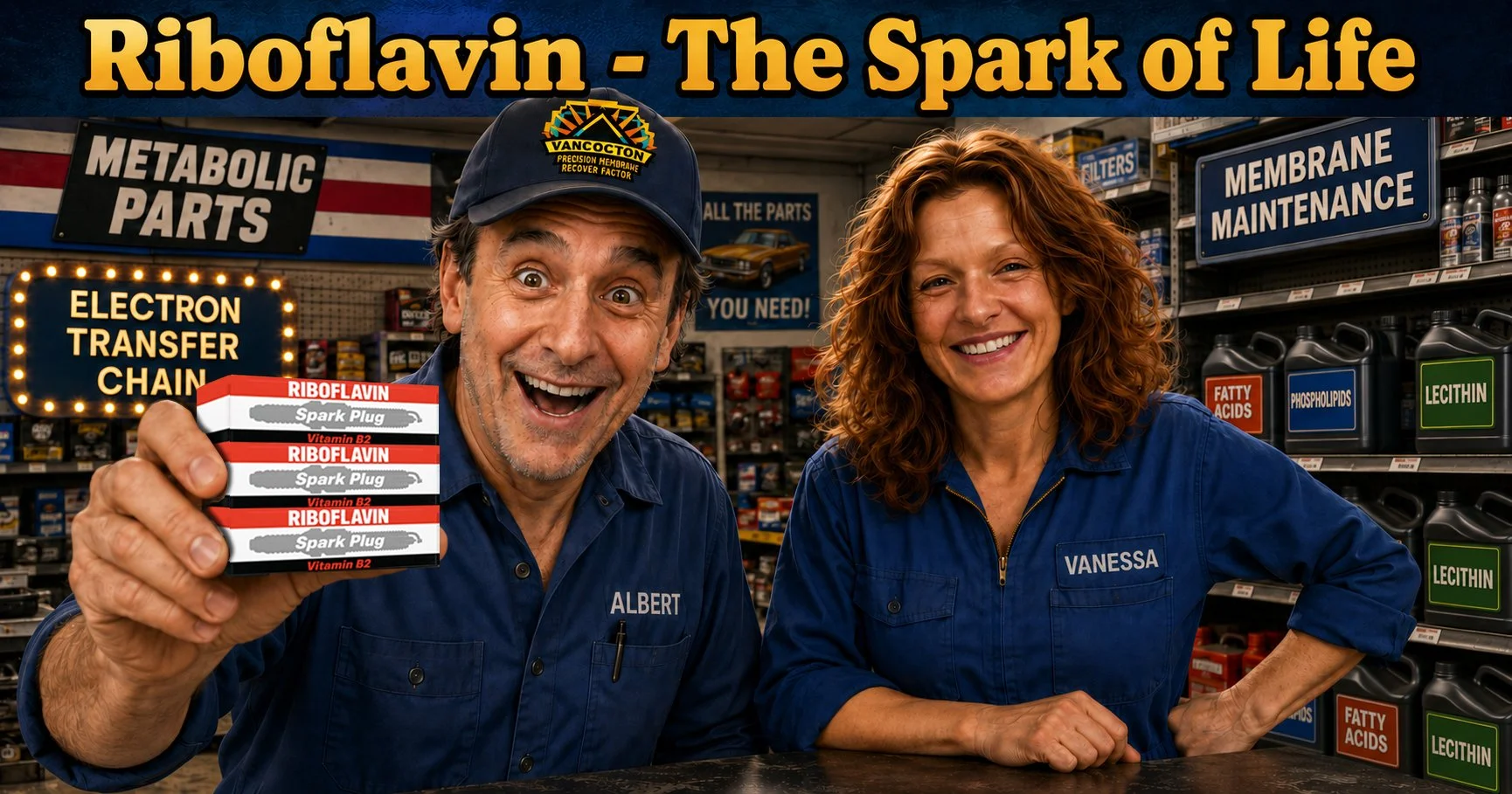
What is Riboflavin?
Riboflavin, also known as vitamin B2, is an essential water-soluble vitamin obtained through foods and dietary supplements. Unlike many vitamins, riboflavin's active forms are continually recycled within cells, allowing remarkably small amounts to support hundreds of cellular reactions.
The human body contains only about 25 milligrams of riboflavin—less than the weight of a grain of rice. Yet that tiny amount helps cells convert food into usable energy, metabolize nutrients, perform cellular respiration, synthesize DNA, produce new cells, and maintain and repair tissues throughout the body. Without it, cells cannot maintain many of the systems required for life.
Many other vitamins and minerals cannot perform their jobs efficiently without adequate riboflavin. Vitamin B2 helps the body utilize nutrients such as vitamin B6, folate, vitamin B12, vitamin A, and iron, among others. For example, some people take large amounts of vitamin B12 or iron hoping to improve their health, but It may not help without enough riboflavin.
Recommended Dietary Intake
If you aren't regularly eating foods rich in riboflavin—and you aren't taking a multivitamin or riboflavin supplement—you may not be getting enough. For simplicity, we'll use an average suggested daily intake of 1.5 milligrams (mg) of riboflavin. Consider how much riboflavin is found in some common foods:
2 eggs: about 0.45 mg (30%)
1 cup milk: about 0.45 mg (30%)
6 oz yogurt: about 0.4 mg (27%)
1 oz almonds: about 0.3 mg (20%)
Liver (3 oz): about 2–3 mg (more than 150%)
Fortified breakfast cereal (1 serving): about 0.8–1.7 mg (53–113%)
Enriched pasta (1 cup, cooked): about 0.3–0.4 mg (20–27%)
During the first half of the 20th century, riboflavin deficiency was common enough that governments considered it a public health problem. They didn't fortify flour because B2 was thought to be a "nice extra." They did it because deficiencies caused significant disease. Beginning in the early 1940s, riboflavin was added to enriched flour throughout the United States.
Today, many health-conscious people intentionally avoid processed foods. As a result, they may consume less riboflavin than previous generations. Unless they replace it with riboflavin-rich foods such as dairy, eggs, and meat—or with other fortified foods or supplements—their intake may be too low.
The Spark Plug Analogy
An easy way to visualize the importance of riboflavin is through a simple analogy. Think of vitamin B2 as a spark plug for life.
A combustion engine cannot efficiently convert fuel into motion without functioning spark plugs. Likewise, cells cannot efficiently convert food into usable energy without riboflavin and the compounds derived from it.
The average car weighs about 2 tons (4,000 pounds), yet six spark plugs together weigh less than a pound. If even a single spark plug fails, the engine loses power and runs rough. The gas tank may be full, but without functioning spark plugs, the car isn't going anywhere.
The same principle applies to riboflavin. We may have more than enough food, vitamins and minerals to support good health, but without enough vitamin B2, our cells cannot efficiently convert that fuel into usable energy, and many other nutrients cannot perform their jobs efficiently either. We lose our get-up-and-go, our energy begins to decline, and as you'll see throughout this article, life can become a rough ride.
Additionally, we don't replace a car’s spark plugs every time we drive it. Riboflavin isn't the fuel—it is a reusable component that helps keep life running.
Riboflavin and Electron Transfer
Like spark plugs firing millions of times during the life of an engine, riboflavin-derived compounds help drive electron transfer reactions throughout the body, including those of the mitochondrial Electron Transfer Chain.
In the article Electron Transfer, Membranes, and Life, we learned that life depends on controlled electron transfer. We can think of mitochondria as the engines of our cells. Just as spark plugs ignite the fuel-air mixture inside a car's engine, riboflavin helps "spark" the Electron Transfer Chain within mitochondria, allowing cells to convert the energy stored in food into usable energy.
Inside cells, riboflavin is converted into two active forms called flavin mononucleotide (FMN) and flavin adenine dinucleotide (FAD). These molecules serve as cofactors—helper molecules that enable dozens of enzymes to transfer electrons during chemical reactions.
Living cells continually move electrons from one molecule to another, capturing energy from food and converting it into forms that power biological processes.
This movement of electrons is called oxidation-reduction (redox). Every time FMN or FAD transfers electrons, it helps control how energy is released, stored, or used inside the cell. Nearly every riboflavin-dependent reaction relies on this carefully regulated process.
Aging is, in large part, the gradual loss of the body's ability to produce energy, repair damage, and replace worn-out cells. Because riboflavin is required for each of these processes, it plays a fundamental role in how well the body maintains itself over time.
Riboflavin at the Crossroads of Metabolism
About one hundred human enzymes require FMN or FAD directly. Because many of these enzymes occupy key positions within metabolism, riboflavin helps support the body's major biological pathways and influences hundreds of downstream reactions.
Some of the major riboflavin-dependent pathways include:
Electron Transfer Chain — cellular energy production
Cellular maintenance — building, repairing, and renewing cell membranes
DNA synthesis and cell division — growth, repair, and tissue renewal
Folate metabolism (MTHFR) — DNA synthesis and homocysteine recycling
Iron utilization and red blood cell production — oxygen transport
Glutathione recycling — antioxidant protection
Nitric oxide production — circulation and blood flow
Respiratory burst (NADPH oxidase) — immune defense
Fatty acid metabolism — energy production and lipid metabolism
Amino acid metabolism — protein metabolism and cellular function
Vitamin B6 activation — amino acid metabolism and neurotransmitter synthesis
Tryptophan conversion to niacin — vitamin B3 production
Choline metabolism — cell membranes and methylation
Purine metabolism — DNA, RNA, and cellular energy (ATP)
Foundations of Cellular Life
Before cells can grow, divide, communicate, or perform any of their specialized functions, they must first meet two fundamental requirements. They need a continuous supply of energy, and they need healthy cellular membranes to sustain life. Riboflavin plays a central role in both.
Energy Production
Every organ, tissue, and cell requires a continuous supply of energy. Mitochondria are the engines of our cells. Riboflavin helps provide the sparks that allow these engines to convert the energy stored in food into ATP, the cell's usable form of energy. That ATP then powers thousands of biological processes throughout the body.
Cellular Membranes
Imagine a car engine with a cracked engine block, leaking head gasket, broken radiator hose, or rusted fuel line. Even if the spark plugs fire perfectly, the engine cannot operate efficiently because the fuel, coolant, oil, and compression can no longer be contained where they belong.
Our cells face a similar challenge. Just as an engine depends on gaskets, hoses, and seals to contain and organize its many fluids and moving parts, every cell depends on phospholipid membranes to separate, organize, and protect its countless chemical reactions. These membranes form the outer boundary of every cell and the walls of its internal compartments, including the mitochondria where most cellular energy is produced.
Healthy cellular membranes require both an adequate supply of phospholipids and the cellular energy needed to assemble, maintain, repair, and continually renew them. Riboflavin plays a central role in providing that energy.
Many enzymes that use FMN and FAD are located within or attached to mitochondrial membranes, where they help transfer electrons during cellular respiration. Together, healthy membranes and riboflavin-dependent electron transfer make efficient energy production possible.
Riboflavin provides the spark.
Phospholipids provide the containment.
Life requires both.
Major Biological Pathways
With the foundations of energy production and healthy cellular membranes in place, cells can organize thousands of chemical reactions into specialized biological systems. Working together, these systems allow the body to grow, adapt, defend itself, and maintain internal balance. Some of the most important are described below.
DNA, RNA, and Cell Division
Every day, billions of cells divide. To do so, they must accurately copy DNA, repair damaged genetic material, produce RNA, and manufacture proteins.
Riboflavin supports these processes through several interconnected metabolic pathways. MTHFR requires FAD to help produce the active form of folate needed for DNA synthesis and cell division.
Riboflavin → FAD → MTHFR → Active Folate → DNA Synthesis → Cell Division
Blood, Oxygen, and Energy
Red blood cells deliver oxygen to tissues for cellular energy production while returning carbon dioxide to the lungs for removal. They are continually produced in the bone marrow to replace older cells as they wear out.
In the bone marrow, riboflavin helps cells utilize folate for DNA synthesis and cell division, and iron for hemoglobin synthesis, the oxygen-carrying protein within red blood cells. It also helps maintain glutathione in its active form, protecting mature red blood cells from oxidative damage throughout their lifespan.
Cell Division
Riboflavin → FAD → MTHFR → Active Folate → DNA Synthesis → Red Blood Cell Production
Hemoglobin
Riboflavin → Iron Utilization → Hemoglobin Synthesis → Oxygen Transport
Maintenance
Riboflavin → FAD → Glutathione Reductase → Reduced Glutathione → Red Blood Cell Protection
Homocysteine Regulation
Homocysteine is produced naturally during normal metabolism and is continually recycled through pathways that depend on active folate and vitamin B12. The same MTHFR-dependent pathway that supports DNA synthesis also helps maintain normal homocysteine metabolism.
Riboflavin → FAD → MTHFR → Active Folate → Homocysteine Recycling
Nitric Oxide and Circulation
Nitric oxide is a signaling molecule that helps regulate blood flow, oxygen delivery, and communication between cells. Nitric oxide synthase depends on FMN and FAD to transfer electrons during nitric oxide production.
Riboflavin → FMN/FAD → Nitric Oxide Synthase → Nitric Oxide
Immune Defense
The respiratory burst is an immune defense during which specialized white blood cells rapidly produce reactive oxygen species that help destroy bacteria, fungi, and other invaders.
This process depends on NADPH oxidase, an enzyme containing FAD.
Riboflavin → FAD → NADPH Oxidase → Respiratory Burst
Antioxidant Protection
Normal metabolism continually produces reactive molecules that must be carefully managed.
Riboflavin helps maintain antioxidant systems that protect proteins, membranes, DNA, and other cellular structures from excessive oxidative stress.
It helps recycle oxidized glutathione back to its reduced, active form. Reduced glutathione is important in red blood cells, where it protects hemoglobin and cell membranes from damage caused by hydrogen peroxide and other reactive oxygen species.
Riboflavin → FAD → Glutathione Reductase → Reduced Glutathione
Additional Roles of Riboflavin
Because riboflavin participates in hundreds of metabolic reactions, its influence extends well beyond the major pathways described above. Riboflavin has additional roles in:
Vitamin A metabolism (conversion of retinol to retinoic acid)
Endocrine and hormonal function
Sleep and circadian rhythm
Brain and neurological function
Hair growth and maintenance
Embryonic development
Putting the Pieces Together
Let's apply what we've learned to a real-world example. Chronic neuropathy—the numbness, tingling, or burning that can develop in the hands and feet—is not a single disease. It is a symptom that can result from problems affecting several different biological systems.
Nerve cells are among the most energy-demanding cells in the body. Maintaining the electrical gradients required for nerve impulses consumes enormous amounts of ATP, making nerves highly dependent on efficient mitochondrial energy production. They also require healthy cell membranes to transmit those electrical signals efficiently. In addition, they depend on a continuous supply of oxygen delivered by red blood cells, adequate circulation to bring that oxygen to the tissues, and antioxidant protection because nerve cells are especially vulnerable to oxidative stress.
Rather than viewing neuropathy as a single problem, we can ask which riboflavin-dependent biological functions may be impaired.
Energy Production
Riboflavin → FMN/FAD → Electron Transfer → ATP → Nerve Function
Membranes
Riboflavin + Phospholipids → Healthy Nerve Cell Membranes
Blood
Riboflavin → FAD → Folate Activation + Iron Utilization → Red Blood Cell Production → Oxygen Delivery
Circulation
Riboflavin → FMN/FAD → Nitric Oxide Production → Blood Flow
Protection
Riboflavin → FAD → Glutathione Recycling → Antioxidant Protection
Conclusion
In this article we’ve learned of the critical importance of riboflavin in energy production, building and maintaining living structure, and activating other vitamins. A deficiency of riboflavin can negatively affect the body in many different ways.
Although required in only tiny amounts, riboflavin helps sustain countless reactions every moment of every day. Few nutrients have such a small physical presence yet a remarkably broad influence on human life.
Albert Wilking
July 17, 2026
260718
Related Articles
The Birth of Living Cells
Life began when nature learned to capture energy and contain it. Explore how electron transfer and membranes made cells—and ultimately all living things—possible.
→ The Origins of Life:Electron Transfer & Membranes
Nutrients Of The Estuary
What we use and where to find it. A straightforward list of foods and nutrients that support membranes, movement, and the balanced conditions the body is built to maintain.
→ Natural Sources: Natural Nutrients
Cellular Aging & Phospholipids
Cell membranes are constantly repaired, replaced, and rebuilt throughout life. Explore how phospholipids support membrane structure, signaling, renewal, and the body’s ability to maintain healthy tissues.
→ Reverse Aging: Cell Renewal
Continue Exploring
Curiosity has a way of leading to unexpected places. Explore the articles below and discover new ideas, old knowledge, practical routines, and the hidden connections that shape how we feel and function every day.
Simple Salve - Simply Perfect
Two ingredients. Thousands of years of historical use. Discover the science behind Simple Salve and why castor oil and beeswax have remained trusted for generations.
→ Simply Perfect: Simple Salve
The Breathing, Pumping Belly
Beneath every breath is a hidden world of pressure, motion, and rhythm. Explore how breathing and the abdomen naturally work together to balance circulation, flexibility, and fluid movement.
→ Explore Breathing: Pump Up The Belly
EP3 and Histamine
Histamine is part of the body’s natural response system, but movement and fluid clearance help determine whether allergies and irritation linger or resolve.
→ The Science Behind: Managing Allergies
Smooth Muscle
Movement is built into the body at every level. Explore how rhythmic smooth muscle activity helps circulate fluids, regulate vessel tone, and reduce swelling throughout the body.
→ Active Living: Exercise Your Organs

A well-maintained classic Cadillac doesn't look beautiful because it's old. It looks beautiful because it has been cared for. Just as every system in a car must work together to keep it running smoothly, every cell in our bodies depends on proper maintenance to perform at its best.