
EP3 Receptors and Smooth Muscle: How the Body Reduces Swelling
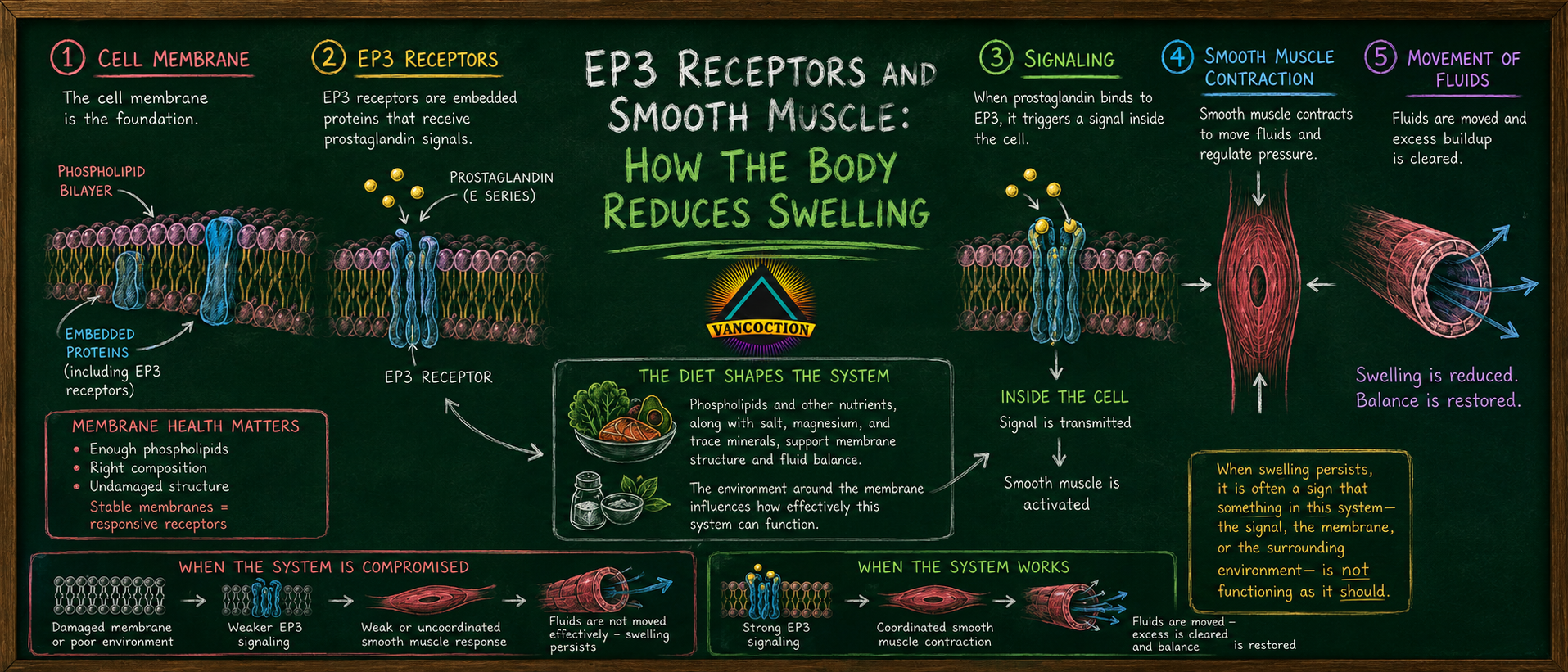
Chalkboard illustration explaining EP3 receptors, phospholipid cell membranes, smooth muscle contraction, and fluid movement involved in reducing swelling.
Throughout the body, cells and their membranes must regulate what comes in and out of them. The cell membrane is dynamic—constantly managing fluid balance, pressure, and the exchange of nutrients, gases, and wastes. When that balance is disrupted, cells can swell. This type of swelling is a form of inflammation and is often associated with pain.
Prostaglandins are signaling molecules that regulate inflammation, fluid movement, and smooth muscle activity. Some promote swelling, while others help resolve it. EP3 receptors are embedded proteins within the cell membrane that receive prostaglandin signals and trigger smooth muscle contraction.
Smooth muscle is the involuntary muscle built into the body’s surfaces, organs, and internal systems. It operates automatically, generating contractions that move fluids, regulate pressure, and drive essential functions throughout the body.
For swelling to resolve, two things must work together: the prostaglandin signal received by EP3 receptors, and the condition of the cell membrane that carries that signal. That signal drives smooth muscle contraction—but its effectiveness depends on the membrane it resides in.
Cell membranes must be structurally sound for this system to work as intended. Built from phospholipids, their performance depends on having enough of them, the right composition, and keeping them in an undamaged state. When compromised, membranes become less stable and less responsive, and their embedded receptors cannot function as effectively.
The environment around the membrane also matters—factors like salt, magnesium, and trace minerals influence fluid balance and smooth muscle responsiveness, shaping how effectively this system can operate.
Because both membrane structure and its surrounding environment depend directly on diet, what you eat plays a direct role in how well this system functions.
When membrane quality is compromised, EP3 signaling becomes less effective. The smooth muscle response it controls can weaken or lose coordination, slowing the movement of fluids and allowing swelling to persist.
When both signal and structure are in place, this system is highly effective. EP3 receptors trigger smooth muscle contraction, fluids are moved, and excess buildup is cleared.
When swelling persists, it is often a sign that something in this system—the signal, the membrane, or the surrounding environment—is not functioning as it should.
Albert Wilking
Continue Exploring
Curiosity has a way of leading to unexpected places. Explore the articles below and discover new ideas, old knowledge, practical routines, and the hidden connections that shape how we feel and function every day.
Nutrients Of The Estuary
What we use and where to find it. A straightforward list of foods and nutrients that support membranes, movement, and the balanced conditions the body is built to maintain.
→ Natural Sources: Natural Nutrients
Simple Salve - Simply Perfect
Two ingredients. Thousands of years of historical use. Discover the science behind Simple Salve and why castor oil and beeswax have remained trusted for generations.
→ Simply Perfect: Simple Salve
The Breathing, Pumping Belly
Beneath every breath is a hidden world of pressure, motion, and rhythm. Explore how breathing and the abdomen naturally work together to balance circulation, flexibility, and fluid movement.
→ Explore Breathing: Pump Up The Belly
EP4 Receptors
Protective surface linings throughout the body depend on fluid movement, hydration, and stable membrane barriers. Explore how these receptors support our most delicate protective systems.
→ Maintain: Natural Barrier Protection
EP3 and Histamine
Histamine is part of the body’s natural response system, but movement and fluid clearance help determine whether allergies and irritation linger or resolve.
→ The Science Behind: Managing Allergies
Cellular Aging & Phospholipids
Cell membranes are constantly repaired, replaced, and rebuilt throughout life. Explore how phospholipids support membrane structure, signaling, renewal, and the body’s ability to maintain healthy tissues.
→ Reverse Aging: Cell Renewal