
EP3 Receptors and Histamine: Reducing Irritation Naturally
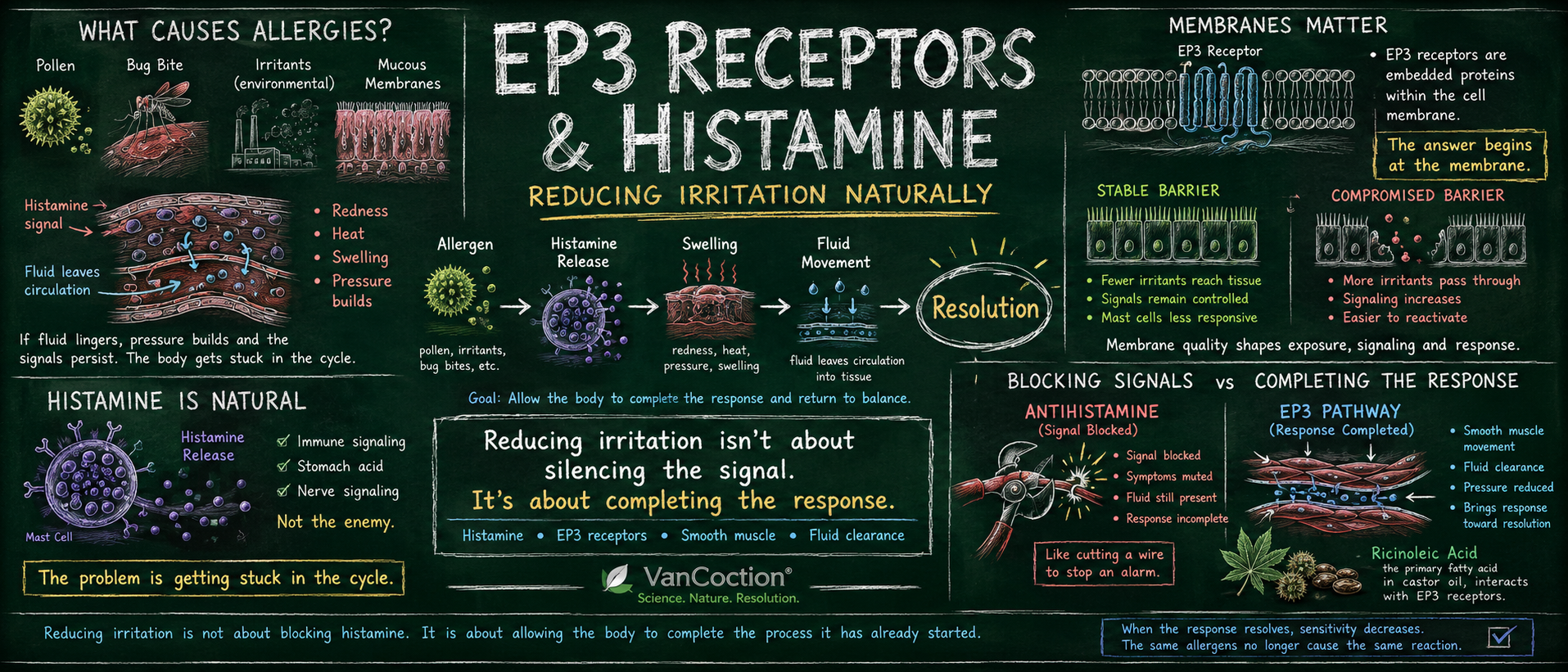
A chalkboard-style scientific illustration exploring EP3 receptors, histamine signaling, smooth muscle contraction, fluid clearance, and natural resolution pathways involved in allergies and irritation.
What Causes Allergies?
Why do some people walk through a field of wildflowers without a second thought, while others react almost immediately—itching, swelling, congestion?
Why does one person get a small bug bite that rapidly fades, while another develops a swollen, irritated patch that festers for days?
In both cases, an allergen contacts the body—landing on a mucous membrane or entering through the skin—and triggers a histamine response. The difference between individuals is not the trigger, but how the body handles the response. The objective isn’t to stop irritation, but to prevent the body from getting stuck in a repeating cycle of reaction—what we commonly call an allergic response, or simply, allergies.
Histamine Is a Natural Response
Histamine is a signaling molecule involved in immune responses, stomach acid secretion, and even nerve signaling—part of the body’s everyday function.
During irritation or injury, it can surge, opening blood vessels and allowing fluid to leave circulation and enter the surrounding tissue. This produces the familiar response of redness, swelling, heat, and pressure. This swelling is not a mistake but part of the body’s natural response.
If that fluid is cleared efficiently, the response resolves and the system returns to baseline. If the fluid lingers, pressure builds and the signals persist.
Blocking Signals vs Completing The Response
Antihistamines like Benadryl (diphenhydramine) work by blocking histamine at its receptors and are commonly used with the goal of reducing symptoms in the short term. But many of these approaches come with what we think of as a “convenience tax”—easy comfort now, with potential trade-offs later. Long-term use of Benadryl has been linked to increased risk of cognitive decline, dementia, dizziness, and loss of balance due to its effects on the nervous system.
By blocking histamine—including in the brain—the signal is shut down. The visible symptoms—itching, swelling, irritation—may be reduced, but the underlying fluid that moved into the tissue still has to be dealt with. It’s similar to cutting a wire to stop an alarm from going off.
Ricinoleic acid, the primary fatty acid in castor oil, interacts with EP3 receptors at the membrane level. Rather than shutting the signal down, this pathway is associated with coordinated smooth muscle contraction and local tissue movement—helping support fluid clearance, reduce pressure, and bring the response toward resolution.
This isn’t about telling someone what not to use. It’s about understanding the difference between suppressing a signal and allowing the body to complete the response.
For a deeper look at how the body moves and clears fluid, see:
EP3 Receptors and Smooth Muscle: How the Body Reduces Swelling
Mast Cells Manage Histamine
Mast cells are specialized cells that store histamine and release it when triggered. EP3 receptors are embedded proteins within the cell membrane that help regulate this response.
But this still does not explain why one person resolves this quickly, while another does not. The answer begins at the membrane.
Membranes and surface barriers regulate what reaches the tissue. In the lungs, skin, and mucous membranes, they control exposure.
When these barriers are stable, fewer irritants reach deeper tissue, signals remain controlled, and mast cells are less responsive. When they are compromised, more irritants pass through, signaling increases, and the system becomes easier to activate.
At that point, the issue is no longer the initial trigger, but that the fluid that has entered the tissue is not being fully cleared. The tissue remains sensitive, and as signaling continues, the response is more easily reactivated.
Histamine Signaling and Resolution
Reducing irritation is not about blocking histamine. It is about allowing the body to complete the process it has already started.
When that happens, swelling subsides, sensitivity decreases, and the same environmental allergens no longer produce the same reaction.
Albert Wilking
Continue Exploring
Curiosity has a way of leading to unexpected places. Explore the articles below and discover new ideas, old knowledge, practical routines, and the hidden connections that shape how we feel and function every day.
Nutrients Of The Estuary
What we use and where to find it. A straightforward list of foods and nutrients that support membranes, movement, and the balanced conditions the body is built to maintain.
→ Natural Sources: Natural Nutrients
Simple Salve - Simply Perfect
Two ingredients. Thousands of years of historical use. Discover the science behind Simple Salve and why castor oil and beeswax have remained trusted for generations.
→ Simply Perfect: Simple Salve
The Breathing, Pumping Belly
Beneath every breath is a hidden world of pressure, motion, and rhythm. Explore how breathing and the abdomen naturally work together to balance circulation, flexibility, and fluid movement.
→ Explore Breathing: Pump Up The Belly
EP4 Receptors
Protective surface linings throughout the body depend on fluid movement, hydration, and stable membrane barriers. Explore how these receptors support our most delicate protective systems.
→ Maintain: Natural Barrier Protection
Smooth Muscle
Movement is built into the body at every level. Explore how rhythmic smooth muscle activity helps circulate fluids, regulate vessel tone, and reduce swelling throughout the body.
→ Active Living: Exercise Your Organs
Cellular Aging & Phospholipids
Cell membranes are constantly repaired, replaced, and rebuilt throughout life. Explore how phospholipids support membrane structure, signaling, renewal, and the body’s ability to maintain healthy tissues.
→ Reverse Aging: Cell Renewal
The Belly Ritual
A simple nightly practice using breath, movement, and topical application to support circulation, flexibility, and overall function while you sleep.
→ Feed Your Body: The Belly Ritual