
EP4 and Membrane Barrier Protection
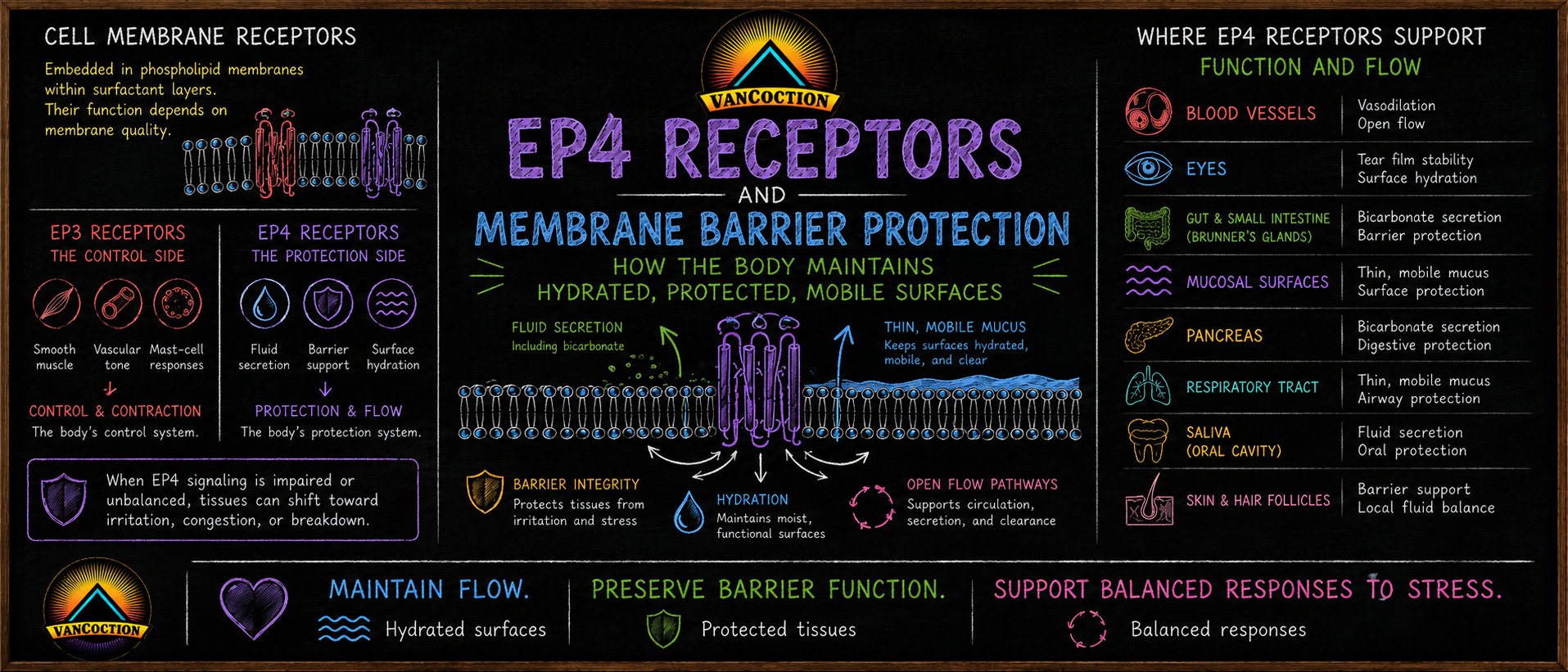
EP4 receptors help maintain hydrated, protected, mobile surfaces throughout the body by supporting barrier integrity, fluid secretion, circulation, and thin mobile mucus layers.
Cell Membrane Receptors
Cell membranes and surfactant layers are built from phospholipids. Embedded within these structures are receptors such as EP3 and EP4, which regulate how fluids move across surfaces and how those surfaces are protected. Phospholipids form the structural environment that allows these receptors to function.
If membrane quality changes, receptor behavior can shift—becoming less responsive, less coordinated, slower to adapt, or in some cases failing to respond at all. This directly affects how effectively tissues maintain protection (EP4) and movement/control (EP3).
EP3 Receptors
They act on smooth muscle, vascular, and mast-cell responses—driving contraction, limiting swelling, and controlling release.
This is the body’s control side of the response.
The body regulates these actions based on what the tissue needs to do. We cover EP3 receptors in more detail in other articles—start here EP3 Receptors and Smooth Muscle.
EP4 Receptors
They support protection of epithelial linings—especially at surface interfaces—by promoting fluid secretion and maintaining a stable barrier. This includes bicarbonate secretion, which helps regulate surface pH and keep mucous layers hydrated and mobile.
This is the protection and flow side of the system.
Epithelial Protection
Fluid Balance
Surfactant System Stability
EP4 receptors influence blood flow, inflammation, and surface protection. Their role is consistent across tissues—maintaining a functional, protected, and well-hydrated interface between the body and its environment.
They are also present in blood vessels, where they are associated with vasodilation (relaxation of smooth muscle), increasing blood flow and helping maintain open flow pathways. This supports both circulation and surface fluid movement.
Changes in this signaling can alter how tissues respond under stress—showing up as irritation, sensitivity, or disrupted flow depending on the location.
EP4 signaling plays a key role in maintaining barrier integrity and regulating inflammatory responses, particularly in epithelial tissues such as the gut.
EP4 receptors support protection, fluid movement, and blood flow across multiple tissues. When this signaling is impaired or unbalanced, it can contribute to irritation, poor fluid handling, or disrupted circulation.
Where EP4 Receptors Support Function and Flow
EP4 receptors support protection, fluid movement, and circulation across key surface and vascular systems. When this signaling is impaired or unbalanced, it can contribute to irritation, congestion, or disrupted flow depending on the location.
In many of these tissues, EP4 helps maintain the integrity of the surface itself—keeping barriers intact while allowing fluids to remain mobile.
Blood Vessels
Supports vasodilation and maintains open flow pathways, helping circulation move efficiently through tissues. Disruption here can contribute to altered blood flow dynamics seen in headaches or vascular stress.
Eyes
Supports tear film stability and surface hydration, helping protect and maintain clear function. Imbalance may contribute to dry eye or surface irritation, and plays a role in broader retinal stress conditions.
Gut and Small Intestine (Brunner’s Glands)
Promotes bicarbonate-rich secretions—particularly from Brunner’s glands—helping neutralize acid and protect the intestinal lining. Impairment here can contribute to irritation and ulcer formation.
Mucosal Surfaces
Supports hydrated, protected linings and helps maintain a thin, mobile mucus layer. When this breaks down, mucus can become thick and stagnant, contributing to congestion and irritation.
Pancreas
Supports bicarbonate secretion into digestive fluids, helping neutralize acidity and protect downstream tissues. Disruption can reduce protective buffering in the digestive tract.
Respiratory Tract
Helps maintain a thin, mobile mucus layer and supports airway surface protection and clearance. Impairment here can contribute to congestion, buildup, reduced airway efficiency, and allergic responses where mucus thickens and clearance is impaired.
Saliva
Supports fluid secretion and oral surface protection. Changes here may contribute to dry mouth, reduced buffering, and increased irritation in the oral cavity.
Skin and Hair Follicles
Supports barrier function, local fluid balance, and vascular flow in the skin environment. EP4 signaling contributes to how the skin and follicles respond to irritation and inflammation. Disruption can contribute to inflammatory skin conditions such as acne.
Conclusion
EP4 receptors operate at the interface—where the body meets its environment and where fluids must move, protect, and adapt. Across blood vessels, airways, digestion, and surface tissues, their role is consistent: maintain flow, preserve barrier function, and support balanced responses to stress.
When this signaling is working well, tissues remain hydrated, protected, and responsive. When it is not, the same systems can shift toward irritation, congestion, or breakdown—showing up differently depending on the tissue, but following the same underlying pattern.
Albert Wilking
Continue Exploring
Curiosity has a way of leading to unexpected places. Explore the articles below and discover new ideas, old knowledge, practical routines, and the hidden connections that shape how we feel and function every day.
Nutrients Of The Estuary
What we use and where to find it. A straightforward list of foods and nutrients that support membranes, movement, and the balanced conditions the body is built to maintain.
→ Natural Sources: Natural Nutrients
Simple Salve - Simply Perfect
Two ingredients. Thousands of years of historical use. Discover the science behind Simple Salve and why castor oil and beeswax have remained trusted for generations.
→ Simply Perfect: Simple Salve
The Breathing, Pumping Belly
Beneath every breath is a hidden world of pressure, motion, and rhythm. Explore how breathing and the abdomen naturally work together to balance circulation, flexibility, and fluid movement.
→ Explore Breathing: Pump Up The Belly
EP3 and Histamine
Histamine is part of the body’s natural response system, but movement and fluid clearance help determine whether allergies and irritation linger or resolve.
→ The Science Behind: Managing Allergies
Smooth Muscle
Movement is built into the body at every level. Explore how rhythmic smooth muscle activity helps circulate fluids, regulate vessel tone, and reduce swelling throughout the body.
→ Active Living: Exercise Your Organs
Cellular Aging & Phospholipids
Cell membranes are constantly repaired, replaced, and rebuilt throughout life. Explore how phospholipids support membrane structure, signaling, renewal, and the body’s ability to maintain healthy tissues.
→ Reverse Aging: Cell Renewal