
The Birth of Living Cells
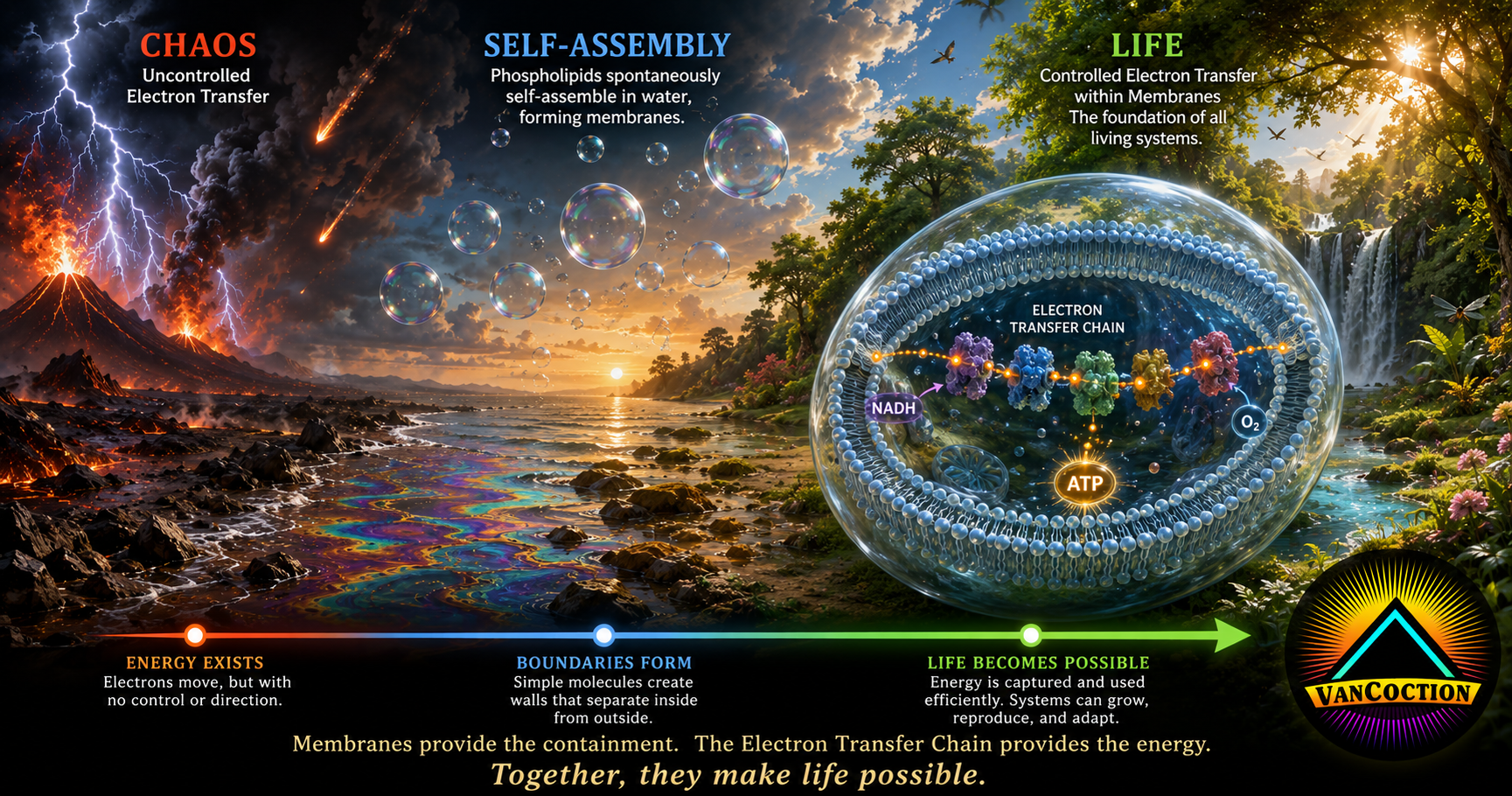
- How Membranes and Electron Transfer Made Life Possible
Long before life existed on Earth, lightning flashed through the sky, iron rusted, and fires burned. Life emerged when it began to contain and control these natural processes. This article explains how that happened.
Lightning, fire, and rust all involve the movement of electrons and the transfer of energy in a process called electron transfer. They do it in an uncontrolled fashion.
Electron transfer occurs when tiny particles called electrons move from one atom or molecule to another, releasing or storing energy in the process. We can think of electron transfer as a form of energy exchange.
Life depends on these same types of energy transfers, but on a much smaller scale. To perform them, life uses the Electron Transfer Chain.
To routinely perform and control the Electron Transfer Chain, life needed to build small, enclosed environments. It uses materials similar to the thin oil slicks we sometimes see floating on water. Phospholipids, fatty molecules, spontaneously self-assemble when in contact with water.
Soap bubbles provide another example of this type of molecule spontaneously self-assembling, and mimic the membrane walls of living cells.
Once life learned how to organize phospholipids into membranes, it could control the energy of the Electron Transfer Chain, giving cells the ability to reproduce, grow, and repair themselves.
Albert Wilking
July 17, 2026
2607
Related Articles
Riboflavin - The Spark of Life
Riboflavin is the vitamin that keeps your cellular engine firing. Learn how vitamin B2 powers energy production, protects tissues, and supports nearly every system in the body.
→ Vitamin B2: The Spark of Life
Nutrients Of The Estuary
What we use and where to find it. A straightforward list of foods and nutrients that support membranes, movement, and the balanced conditions the body is built to maintain.
→ Natural Sources: Natural Nutrients
Cellular Aging & Phospholipids
Cell membranes are constantly repaired, replaced, and rebuilt throughout life. Explore how phospholipids support membrane structure, signaling, renewal, and the body’s ability to maintain healthy tissues.
→ Reverse Aging: Cell Renewal
Continue Exploring
Curiosity has a way of leading to unexpected places. Explore the articles below and discover new ideas, old knowledge, practical routines, and the hidden connections that shape how we feel and function every day.
Nutrients Of The Estuary
What we use and where to find it. A straightforward list of foods and nutrients that support membranes, movement, and the balanced conditions the body is built to maintain.
→ Natural Sources: Natural Nutrients
Simple Salve - Simply Perfect
Two ingredients. Thousands of years of historical use. Discover the science behind Simple Salve and why castor oil and beeswax have remained trusted for generations.
→ Simply Perfect: Simple Salve
The Breathing, Pumping Belly
Beneath every breath is a hidden world of pressure, motion, and rhythm. Explore how breathing and the abdomen naturally work together to balance circulation, flexibility, and fluid movement.
→ Explore Breathing: Pump Up The Belly
EP3 and Histamine
Histamine is part of the body’s natural response system, but movement and fluid clearance help determine whether allergies and irritation linger or resolve.
→ The Science Behind: Managing Allergies
Smooth Muscle
Movement is built into the body at every level. Explore how rhythmic smooth muscle activity helps circulate fluids, regulate vessel tone, and reduce swelling throughout the body.
→ Active Living: Exercise Your Organs
Cellular Aging & Phospholipids
Cell membranes are constantly repaired, replaced, and rebuilt throughout life. Explore how phospholipids support membrane structure, signaling, renewal, and the body’s ability to maintain healthy tissues.
→ Reverse Aging: Cell Renewal