
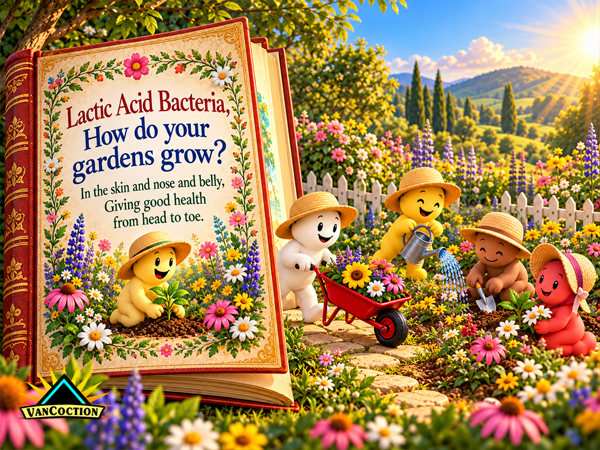
All of us grow garden communities of tiny organisms on our bodies.
Lactic Acid Bacteria,
How do your gardens grow?
In the skin and nose and belly,
Giving good health from head to toe.
How do we protect ourselves from disease?
How do we prevent pathogenic bacteria, fungi, parasites, and viruses from infecting us?
The answer is to feed the good bacteria already growing on us. These bacteria live on our exterior membranes, the thin, pliable layers of tissue that come in contact with the outside world. We call a community of these tiny organisms, or microbes, a microbiome.
We can think of microbiomes as living gardens, with different microbes growing together and competing for space and nutrients. Microbiomes can be a collection of good and bad microbes, and can vary greatly depending upon where they live on us.

What kind of bacteria do you want living on you? Sterilize your microbiome gardens, and you create a free-for-all for bad bacteria, fungi, and viruses to grow, spread, and give you an infection.
We don’t just have microbiomes living on the visible surfaces of our bodies. They also live in our digestive tracts, respiratory tracts, and even our ear canals. Anywhere that our membranes interface with the outside world, we have microbiomes.
If the needs of our exterior membranes are met by our own internal systems, and by our habits and behaviors, they will support healthy microbiomes. The health of our membranes helps determine which microbes live on us, and the quality of our microbiomes can also affect the health of our membranes.
Our bodies constantly work to maintain a microbe-free internal environment. But our exposed membrane barriers do not remain sterile. Once they meet the outside world, bacteria will colonize them. There is no stopping this. So the important question is: what kind of bacteria do we want living on us?
When our membranes are healthy and well nourished they naturally feed lactic acid bacteria (LAB). LAB produce lactic acid, creating acidic conditions that support LAB while killing harmful microbes.
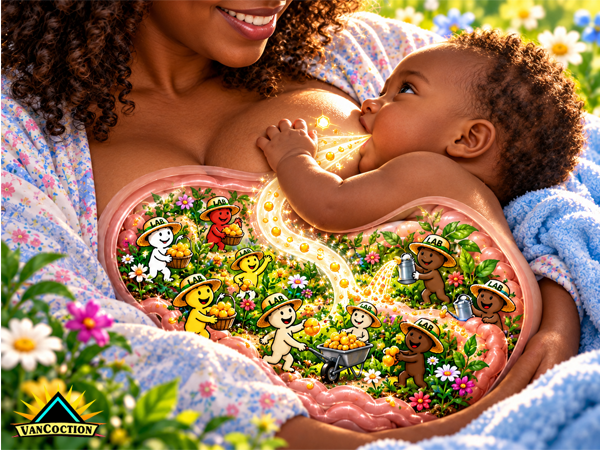
Breast milk feeds both the baby and its developing microbiome gardens.
During pregnancy, these living habitats become especially rich and well nourished. The “pregnancy glow” is a common term describing a pregnant woman’s radiant skin. In her birth canal, LAB flourish, often approaching 100% of the bacterial community.
Inside the womb, the baby has not yet developed the microbiomes that will protect its exposed membranes. At birth, as the baby travels through the birth canal, it is bathed in its mother’s LAB-rich microbiome. Her microbiome plants the original seeds of the baby’s lifelong microbiome gardens.
Breastfeeding continues this process. A mother’s milk feeds both the baby and the beneficial bacteria living in the baby’s developing intestinal microbiomes. Breast milk has special sugars that selectively feed these beneficial bacteria, helping them thrive. Together, natural birth and breast milk help develop the baby’s LAB-rich microbiomes.

A thriving LAB community leaves little room or food for troublemakers..
A LAB-rich microbiome is our baseline. Natural birth gives us our first microbial gardens, and breastfeeding feeds them. This protective partnership between our membranes and microbiomes begins at birth and continues throughout our lives.
Like any garden, a microbiome can be damaged by the way we treat it. Constant washing, antiseptics, antibiotics, and other antimicrobial chemicals can remove beneficial bacteria and change their environment, lowering our defenses. Like weeds overtaking a garden, infection occurs when pathogens crowd out the beneficial microbes we want growing there.

The happy egg exists in relationship with its shell and the microbes living on its surface. The sad egg has been stripped clean of its natural protection and must now live in a refrigerator.
Think about the natural bloom on a freshly laid egg. Washing away that protective coating changes the egg’s natural defenses, which is why commercially washed eggs require refrigeration. Our bodies are far more complex, but the lesson is similar: when nature builds a protective living surface, continually stripping or disrupting it will have consequences.
Lactic acid attacks and kills harmful microbes by disrupting their cells and cellular processes. At the same time, our own exterior cell membranes thrive in the naturally acidic conditions.
Our microbiomes are our first line of defense against disease. We are constantly exposed to harmful bacteria, fungi, parasites, and viruses through the air we breathe, the things we touch, and what we eat and drink. Healthy microbiomes live on healthy membranes, and together they these harmful microbes from infecting us. When we nourish this relationship, we strengthen our defense against disease. When we disrupt it—through damage, chemicals, medications, poor nutrition, or other influences—we create opportunities for pathogens to take over.
Good health begins by taking care of the gardens already growing on us. Feed them. Protect them. Give the good bacteria what they need to thrive, and they will help protect us from birth until the day we die.
The Science of Lacticil: Discover how lactic acid penetrates and kills harmful microorganisms while supporting the skin’s natural defenses. Explore the science behind Lacticil’s carefully selected ingredients and how they work together to promote healthy skin, maintain an acidic environment, and support a balanced microbiome.
In Stock Now - Lacticil — Get Your Microbiome Back to Baseline.
https://www.vancoction.com/store/p/lacticil
Learn More
The Science of Lacticil
Discover how lactic acid penetrates and kills harmful microorganisms while supporting the skin’s natural defenses by supporting a balanced microbiome
→ Lacticil Supports Healthy Microbiomes: The First Line of Immunity Defense
The Birth of Living Cells
Life began when nature learned to capture energy and contain it. Explore how electron transfer and membranes made cells—and ultimately all living things—possible.
→ The Origins of Life: Electron Transfer & Membranes
Nutrients Of The Estuary
What we use and where to find it. A straightforward list of foods and nutrients that support membranes, movement, and the balanced conditions the body is built to maintain.
→ Natural Sources: Natural Nutrients
Cellular Aging & Phospholipids
Cell membranes are constantly repaired, replaced, and rebuilt throughout life. Explore how phospholipids support membrane structure, signaling, renewal, and the body’s ability to maintain healthy tissues.
→ Reverse Aging: Cell Renewal
Conditions Improved Through Better Membrane Health
What happens when the body has the materials it needs to build and maintain healthy membranes? Explore the wide range of conditions and body systems affected when membrane health improves.
→ Conditions Improved: A Comprehensive List