
The Breathing Pumping Belly
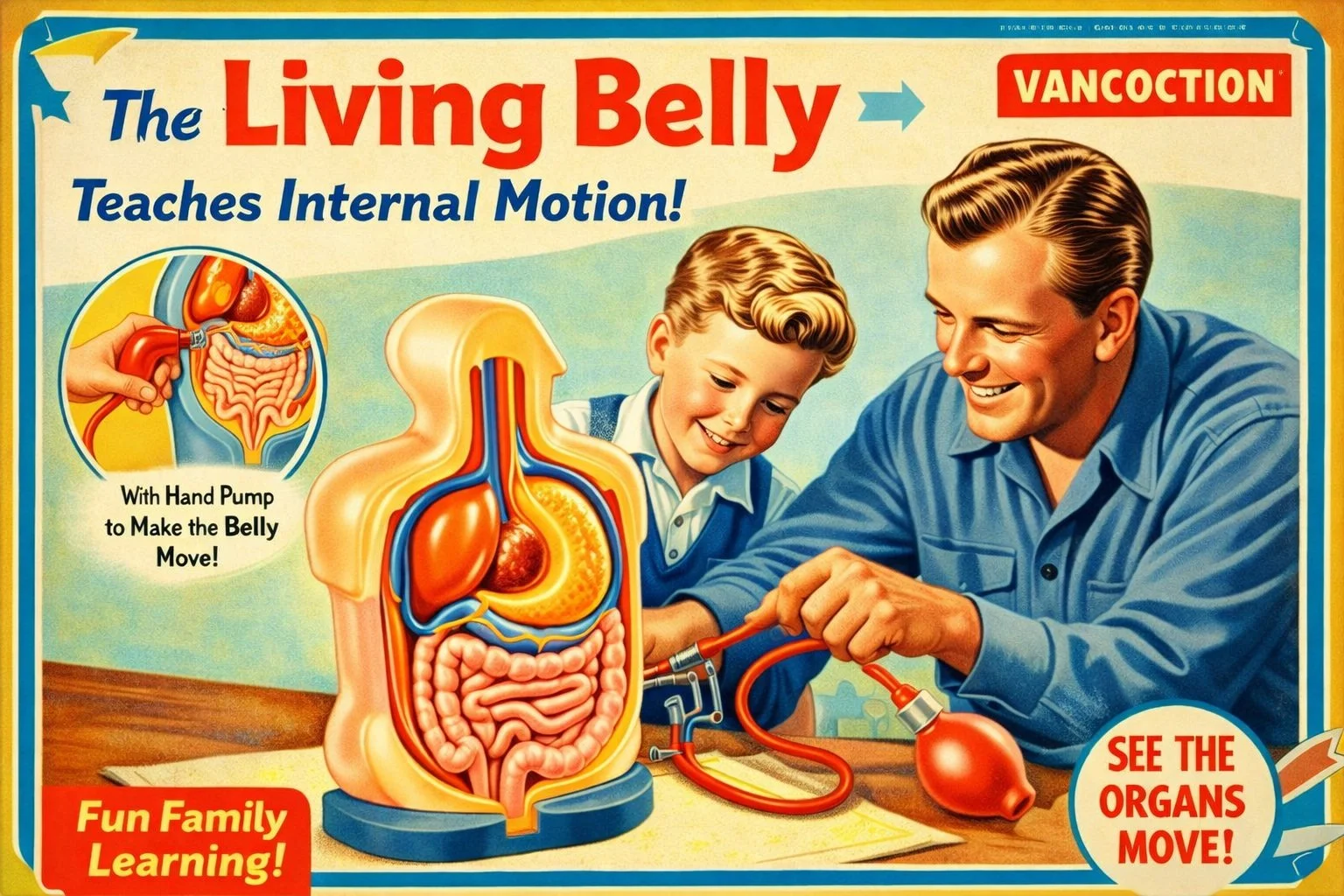
A playful model of the belly as a system of motion.
The Breathing Pumping Belly
Life is a play between opposites — light and dark, hot and cold, fullness and emptiness. We continually adjust to life’s shifting conditions to maintain balance.
Homeostasis
Within us, vast networks of interacting systems work together to maintain internal stability. The coordination and orchestration of these systems is called homeostasis. Homeostasis continuously regulates thousands of chemical and physical processes, maintaining the body’s balance amid ever-changing conditions inside and outside the body. When the body’s structures are intact, its fluids are moving, and its systems working in coordination, it remains in balance — shipshape and ready for action.
One familiar example of homeostasis is temperature regulation. Humans maintain an average internal temperature of about 98.6°F (37°C), and even small shifts can produce noticeable effects, while larger changes can quickly become dangerous.
If the temperature outside drops, the body works to conserve heat — we may shiver, our skin tightens, and warmth is held closer to the core. If conditions become hot, the body releases heat — blood moves toward the skin and we begin to sweat. In this way, the body continually adjusts to maintain a stable internal temperature.
Although this creates stability, the process itself is dynamic. The body is constantly sensing change and making small adjustments like these through breathing, circulation, hormones, digestion, and cellular metabolism.
Homeostasis Before Birth
Before birth, the developing baby lives in a world where its needs are continuously met within the mother’s womb.
The womb provides a remarkably stable environment. Temperature remains steady, light is dim, sounds are softened, and the baby is cushioned and supported by surrounding fluids. Through the umbilical cord, oxygen, nourishment, and fluids flow to the baby while waste products are carried away.
This protection and support gives the baby a safe place to develop its own internal self-regulating systems — circulation develops, hormones begin functioning, tissues form, and internal chemistry begins to stabilize. Because the surrounding environment remains so stable, these systems can develop without the stresses and fluctuations of the outside world.
In this way, the developing baby knows only the comfort and harmony of the womb — a place where balance is reliably maintained.
Birth Jump Starts Life Systems
At birth, the baby leaves the cushioned world of the womb and enters a world of variables — where light, sound, temperature, and the availability of food and water are always changing.
To survive in this new environment, the infant must now maintain its own homeostasis in relation to these conditions. Life systems must begin working immediately — breathing for oxygen, digesting food, managing fluids, and clearing wastes.
From this moment forward, survival depends on sensing internal needs and responding to them.
Listening to Our Intuition
Hunger, thirst, discomfort, fatigue, and the need for warmth or touch are among the first signals a newborn experiences. For the first time, the infant must recognize messages coming from within — signals that something has drifted out of balance and needs attention.
A baby’s main way of communicating these signals is crying. At first, the infant does not know what each signal means. A wet diaper may sting the skin, hunger may cause a hollow discomfort, or fatigue may bring irritability. The baby simply feels that something is wrong and cries.
When a parent responds — feeding, changing, or comforting — the discomfort fades. Over time, the infant begins to associate specific sensations with specific needs. In this way, we gradually learn the body’s language.
We learn that certain feelings mean hunger, others mean thirst, fatigue, or the need for movement. Learning to recognize these cues becomes an important part of maintaining balance throughout life.
As adults, we are still responsible for identifying our own internal needs, but sometimes our habits and conditioning make these cues difficult to recognize or interpret correctly. For example, a person may reach for food when the body is actually asking for water. Over time, repeatedly misreading these signals can pull us out of rhythm with the body’s needs.
Responding immediately to a signal is not always the right choice either. Recently, I placed a bird feeder outside our home. Within minutes, a female cardinal arrived, followed by a male. They both looked carefully at the feeder but never touched the food. We have outdoor cats, and the birds seemed to sense the danger. Hunger may have drawn the birds there, but instinct told them something was not right. The birds flew away without eating. They did not simply obey their impulse to feed — they evaluated the situation first.
Sometimes what we call intuition — often described as a “gut feeling” or “gut instinct” — may simply be our ability to recognize and interpret both our senses and our internal cues. Our bodies are not managing just one condition, but thousands of signals, conditions, and processes at once, all being continuously orchestrated so that we remain stable and functional. How do we determine which signals deserve our attention?
The gut is not just a passive organ of digestion. It contains its own network of nerves known as the enteric nervous system, sometimes referred to as the “second brain.” This system operates largely outside of conscious control, sensing and responding to conditions within the abdomen while coordinating processes such as movement, secretion, and blood flow. It communicates with the brain, but it also functions on its own. Many of the signals we experience as instinct — such as hunger, fullness, discomfort, or the urge to move or rest — arise from this internal network. In this way, what we call a “gut feeling” is not abstract, but rooted in the body’s ongoing effort to maintain balance.
Often, we respond to discomfort by trying to quiet or numb the feeling rather than understanding it. Stress from work, for example, might lead someone to pour a drink, reach for food, or light a cigarette. Over time, these small satisfactions can become associated with relief, even when the body was asking for something entirely different. The signal may not have been hunger at all — it may have been dehydration, fatigue, or the need to shift and circulate fluids within the body.
In these moments, we may be filling ourselves when what the body really needs is pumping.
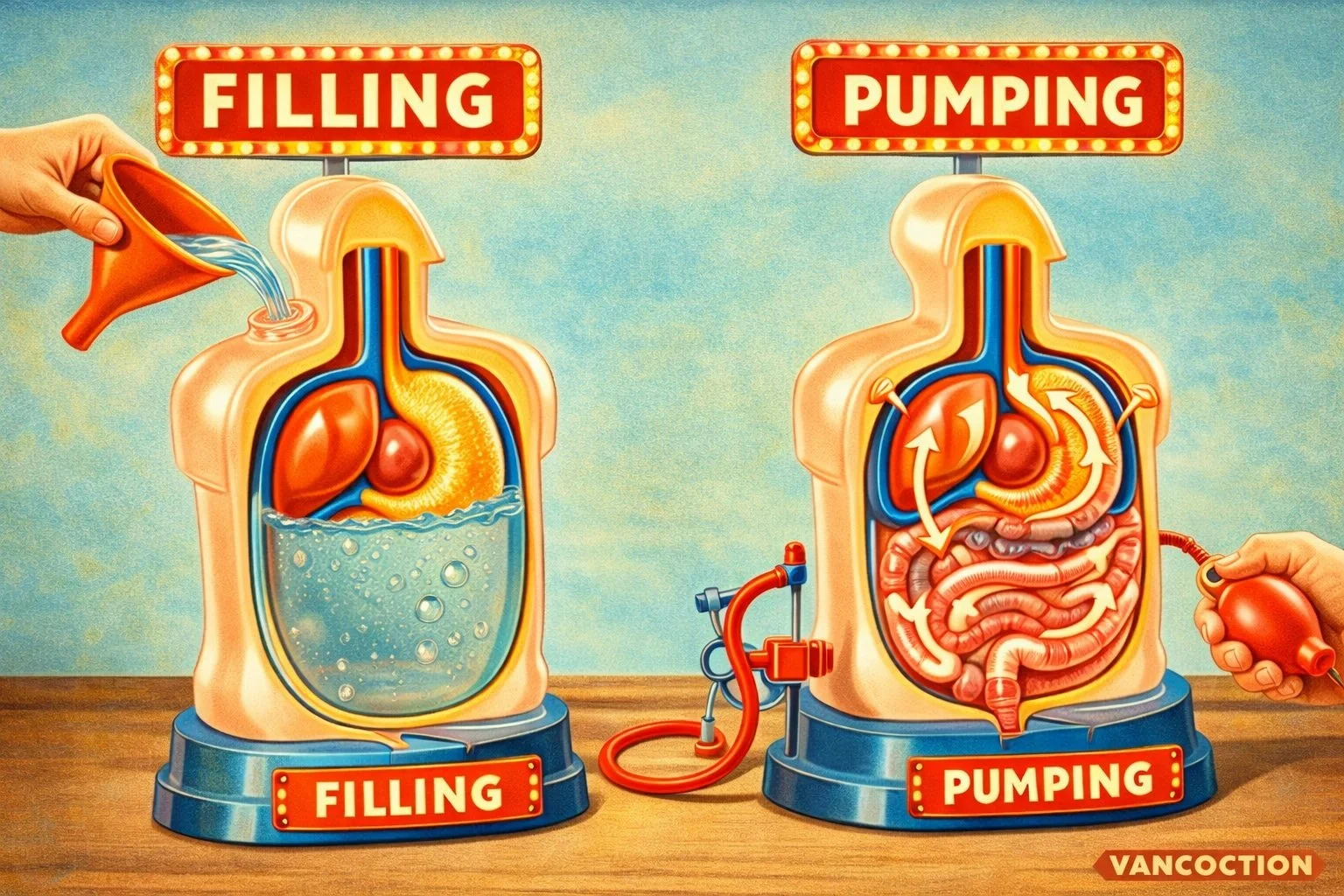
Each breath helps shift pressure, fluids, and internal motion.
The Belly’s Pumping Orchestra
Internal balance is not optional. If even a single critical element or state moves too far out of range — whether in blood sugar, oxygen, temperature, acidity, or many other factors — the consequences can be immediate and severe.
The belly is often thought of as a filling station — eat a meal, fill it up, and move on. In reality, the abdomen functions as both a filling station and a pumping station, where fluids, gases, nutrients, and cellular materials are constantly being moved, processed, and redistributed throughout the body.
When people are asked to name a pump in the body, the first answer is almost always the heart — and for good reason. The heart is the central pump of the circulatory system, beating continuously throughout our lives and pushing blood through the vessels of the body.
But the heart does not pump alone. Other pumping systems also operate within the abdomen.
They include:
• The diaphragm pump — created by breathing and pressure changes
• Smooth muscle contractions — which drive the movement of fluids through organs, vessels, and ducts
• The lymphatic pump — where vessels rhythmically move lymph upward
• Skeletal muscle movement — which compresses and releases abdominal tissues
Together, these abdominal pumps work alongside the heart, forming a coordinated network that helps keep circulation, digestion, and fluid movement operating smoothly throughout the body.
Membranes Keep Us Whole
So how do all of these pumping and filling stations — these vessels and organs — stay organized and function without leaking their contents?
For the body’s pumping systems to move fluids effectively, those fluids must first be contained and guided. This is the role of biological membranes. A membrane is a thin living boundary that separates spaces in the body while controlling what moves across it.
Membranes are made of cells, and each cell has its own outer boundary. In this way, membranes appear repeatedly throughout the body: the skin forms an outer membrane, organs have their own protective layers, and the cells that form those organs each have membranes.
Similar linings form the inner surfaces of blood vessels, lymphatic vessels, and the digestive tract, helping contain and guide fluids, nutrients, and food materials as they move through the body.
Membranes therefore serve two essential functions. First, they contain fluids within specific spaces. Second, they regulate what can move across these boundaries — allowing some materials to pass while restricting others. In this way these thin layers help maintain the chemical conditions and fluid balance required for cells, tissues, and organs to function properly.
The importance of these biological barriers cannot be overstated. Pumps require tight containment to maintain pressure and direction of flow. Just as a pinhole in a tire or a water pump can cause it to leak, weakened biological barriers can allow fluids to escape or move in the wrong direction inside the body.
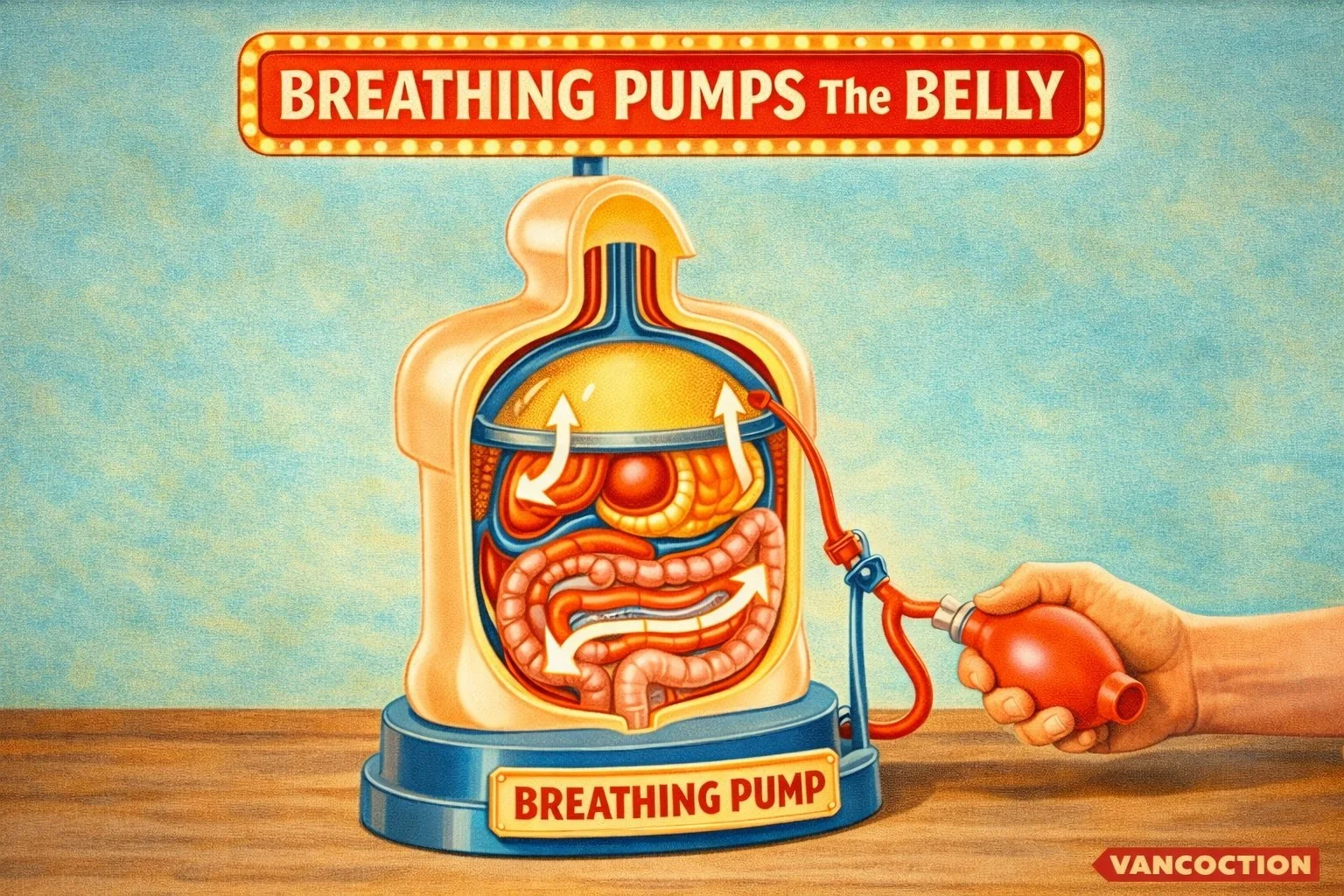
Each breath helps shift pressure, fluids, and internal motion.
Breathing Pumps the Abdomen
Breathing also plays a major role in circulating fluids through the abdomen by creating rhythmic changes in pressure within the abdominal cavity.
The diaphragm is a dome-shaped muscle that separates the chest from the abdominal cavity. It is attached to the lower ribs, the sternum, and the lumbar spine, forming a flexible muscular partition between the lungs above and the abdominal organs below.
When the diaphragm contracts during inhalation, the dome of the muscle flattens and moves downward. During shallow breathing the diaphragm may move only about one or two centimeters, but during deeper breathing it can descend seven to ten centimeters. This movement allows the lungs to expand while gently compressing the abdominal cavity beneath them. Because the abdomen contains mostly fluid, soft tissues, and movable organs, this compression increases pressure throughout the abdominal space.
As the diaphragm descends, pressure rises in the abdomen while pressure inside the chest decreases. This pressure difference helps draw venous blood and lymphatic fluid upward toward the heart. When the diaphragm relaxes during exhalation, pressure shifts again and the abdominal organs return toward their resting position.
Because we breathe more than 20,000 times each day, this cycle of compression and release functions as a continuous mechanical pump that helps support circulation and lymphatic drainage.
Smooth Muscles Are Movers and Shakers
In addition to the pressure changes created by breathing, many abdominal structures contain layers of smooth muscle that generate their own rhythmic contractions.
Smooth muscle is different from the skeletal muscle that moves our arms and legs. Rather than being controlled consciously, it works automatically within the walls of organs and vessels throughout the body. These muscles contract and relax to move fluids and materials.
Throughout the abdomen, these contractions appear in a wide range of systems and functions, including:
• Peristalsis — coordinated waves of contraction that move food and digestive fluids through the digestive tract. Rings of muscle tighten behind food while relaxing ahead of it, gradually pushing material forward through the intestines.
• The gallbladder — a muscular reservoir that rhythmically squeezes stored bile into the small intestine to help digest fats, sometimes referred to as a ‘squeeze ball’.
• Tubular organs such as the urinary tract and bile ducts — where coordinated contractions move fluids.
• Blood and lymph vessels — where smooth muscle helps regulate circulation and fluid flow.
Circulation Keeps Traffic Moving
The pressure changes created by breathing and body activity help drive circulation through the vessels that supply the abdominal organs. The veins from the stomach, intestines, pancreas, and spleen merge to form the portal vein, which carries blood directly to the liver before it returns to the rest of the body.
This design ensures that most water-soluble nutrients absorbed from the digestive tract are first delivered to the liver, where they can be stored, modified, or broken down before entering the wider circulation.
The liver sits in the upper right portion of the abdomen just beneath the diaphragm and is the largest internal organ in the body. Because of this position, each movement of the diaphragm during breathing compresses and releases the liver. These rhythmic pressure changes help move blood through the liver’s dense network of vessels.
At rest, about 1.3 to 1.5 liters of blood pass through the liver every minute. Nearly all blood leaving the digestive organs flows through this system before returning to the heart and circulating throughout the body.
Through this continuous processing and redistribution of blood, the liver functions as a central hub in the body’s circulatory and metabolic network.
When the body’s pumping systems are weakened, fluids and metabolic by-products can begin to accumulate in tissues. This can place additional strain on the circulatory system and the heart and, over time, contribute to broader systemic dysfunction. Impaired circulation is associated with conditions such as edema, venous congestion, fatty liver disease, chronic digestive problems, and other systemic disorders.
The Lymphatic System Pumps Upwards
Running alongside the blood vessels is the lymphatic system, which collects excess tissue fluid, proteins, immune cells, and fats absorbed from the intestines.
Within the abdomen, these materials move through lymphatic vessels toward a central reservoir called the cisterna chyli, located deep in the upper abdomen along the spine near the first and second lumbar vertebrae — several centimeters above and behind the level of the navel.
Because the cisterna chyli lies directly beneath the diaphragm within the pressure field created by breathing, each descent of the diaphragm helps compress surrounding tissues and push lymph upward through the body’s central lymphatic channels.
Along the way, the lymphatic system transports fats absorbed from the digestive tract, along with fluid and immune cells, before returning them to the bloodstream near the heart.
When lymphatic movement slows, fluid and immune materials can accumulate in tissues, contributing to many of the same patterns of congestion and dysfunction seen in impaired circulation.

Movement amplifies the body’s natural pumping systems.
Examples in Motion
How do we bring these internal systems to life?
Through movement that engages the breath, the belly, and the body together.
When we move in this way, the diaphragm descends and rises, the abdominal wall contracts and releases, and pressure shifts through the entire cavity — helping move blood, lymph, and fluids throughout the body.
Even simple movement can begin this process. Walking with steady breathing creates a gentle rhythm of motion through the abdomen.
More dynamic movement increases the effect. Activities like jumping rope or rebounding introduce repeated impact and rapid pressure changes, causing the organs and surrounding tissues to shift and respond.
And sometimes it happens without effort at all — in laughter, when the breath becomes forceful, the belly contracts, and the body moves in waves.
These are not just exercises. They restore internal motion — the conditions that allow the body’s systems to circulate, respond, and function as they are designed to, including highly responsive tissues like the omentum.
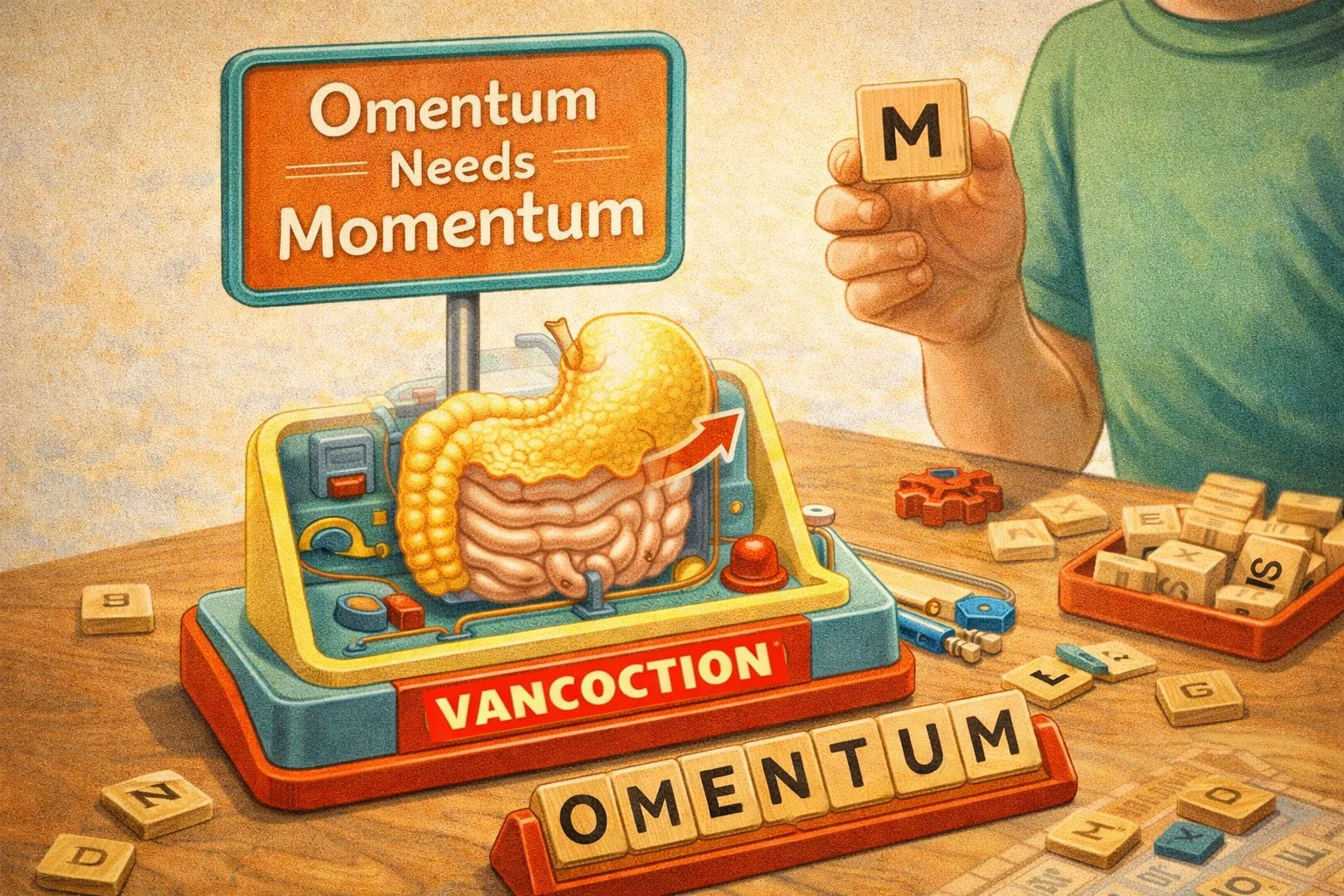
Responsive tissues depend on motion, pressure, and flow.
The Peritoneum and Omentum
The abdominal cavity is lined by a thin membrane called the peritoneum. Rather than simply forming a boundary, this membrane lines the inner wall of the abdomen and then folds over and around the organs, like a sheet draped over objects, creating a continuous system that supports and connects them while allowing movement.
Within this membrane system lies the omentum, a soft, apron-like fold that drapes over the intestines. Rich in blood vessels, lymphatic channels, and immune activity, it is not a pump itself, but it exists within constant motion. As breathing, movement, and pressure changes shift the organs and fluids of the abdomen, the omentum folds, glides, and repositions, helping distribute these forces throughout the cavity.
The omentum is also highly responsive. In the presence of irritation or injury, chemical signals act like a beacon within the abdominal cavity, drawing it toward affected areas where it can adhere, help contain inflammation, and support repair. Rather than moving independently, it responds to the body’s internal signals and mechanical forces, allowing it to be guided to where it is needed.
The omentum depends on movement, pressure changes, and fluid dynamics to function. In a sedentary state, these forces are reduced, limiting how effectively it can shift, respond, and participate in repair. The body is designed to function in motion. When we move, we don’t just work muscles — we restore the internal conditions that allow tissues like the omentum to shift, respond, and do their job.
The Living, Breathing, Pumping Belly
Within the belly, multiple systems coordinate through pressure and activity to keep fluids circulating and tissues functioning. When these systems function as designed, they help maintain homeostasis, and we feel at ease. When they become impaired, we feel it as heaviness, swelling, and discomfort.
Often the body quietly signals what it needs. These signals are not always instructions, but information — part of an ongoing dialogue within the body. What we think of as gut intuition may arise from the digestive tract itself, which contains its own network of nerves — often referred to as the body’s “second brain.”
Over time, habits can override these signals — as the conscious mind begins to act independently rather than in partnership with the belly.
When the brain and gut are working together in a harmonious partnership, the body maintains a steady homeostasis — balanced, responsive, and easy to sustain.
With so many variables in human life, good health depends on maintaining a relationship between the conscious mind and the body’s internal intelligence, with the two acting together as conductors — guiding the rhythm of an orchestra of systems that is the body.
Albert Wilking
260330Simple Salve
Two ingredients. Thousands of years of historical use. Discover the science behind Simple Salve and why castor oil and beeswax have remained trusted for generations.
→ Simply Perfect: Simple Salve
The Belly Ritual
A simple nightly practice using breath, stretching, and Simple Salve to improve circulation, organ function, and flexibility while you sleep.
→ Loving Sleep: The Belly Ritual
Cellular Aging & Phospholipids
Cell membranes are constantly repaired, replaced, and rebuilt throughout life. Explore how phospholipids support membrane structure, signaling, renewal, and the body’s ability to maintain healthy tissues.
→ Reverse Aging: Cell Renewal
Nutrients Of The Estuary
What we use and where to find it. A straightforward list of foods and nutrients that support membranes and the balanced conditions the body must maintain.
→ Simple Sources: Natural Nutrients
EP3 Receptors and Histamine
Lessen allergies and irritation by contracting, circulating, and the moving fluids out of tissues.
https://www.vancoction.com/news/ep3-receptors-histamine-reducing-irritation
Membranes Empower Life
Membranes are required for life, and for a healthy life, they must be well maintained.
https://www.vancoction.com/news/membranes-empower-life
Gentle Membrane Immunity
How balanced membranes support immune defense without unnecessary inflammation.
https://www.vancoction.com/news/gentle-membrane-immunity
Nutrients of the Estuary: Feeding Life
A look at the mineral and environmental context that supports healthy membrane chemistry and the essential co-factors involved.
https://www.vancoction.com/news/nutrients
Lecithin and Feeling Good
How membrane structure connects to mood, resilience, and overall vitality.
https://www.vancoction.com/news/lecithin-feeling-good
Balancing Oxygen, Blood Glucose and the Immune System
How oxygen delivery and metabolic balance influence membrane stability and renewal.
https://www.vancoction.com/news/balance-oxygen-sugar-immune